
Electrolysis Permanent Hair Removal
The only FDA approved method of permanent hair removal, Electrolysis treatment is suitable for all hair and skin types.
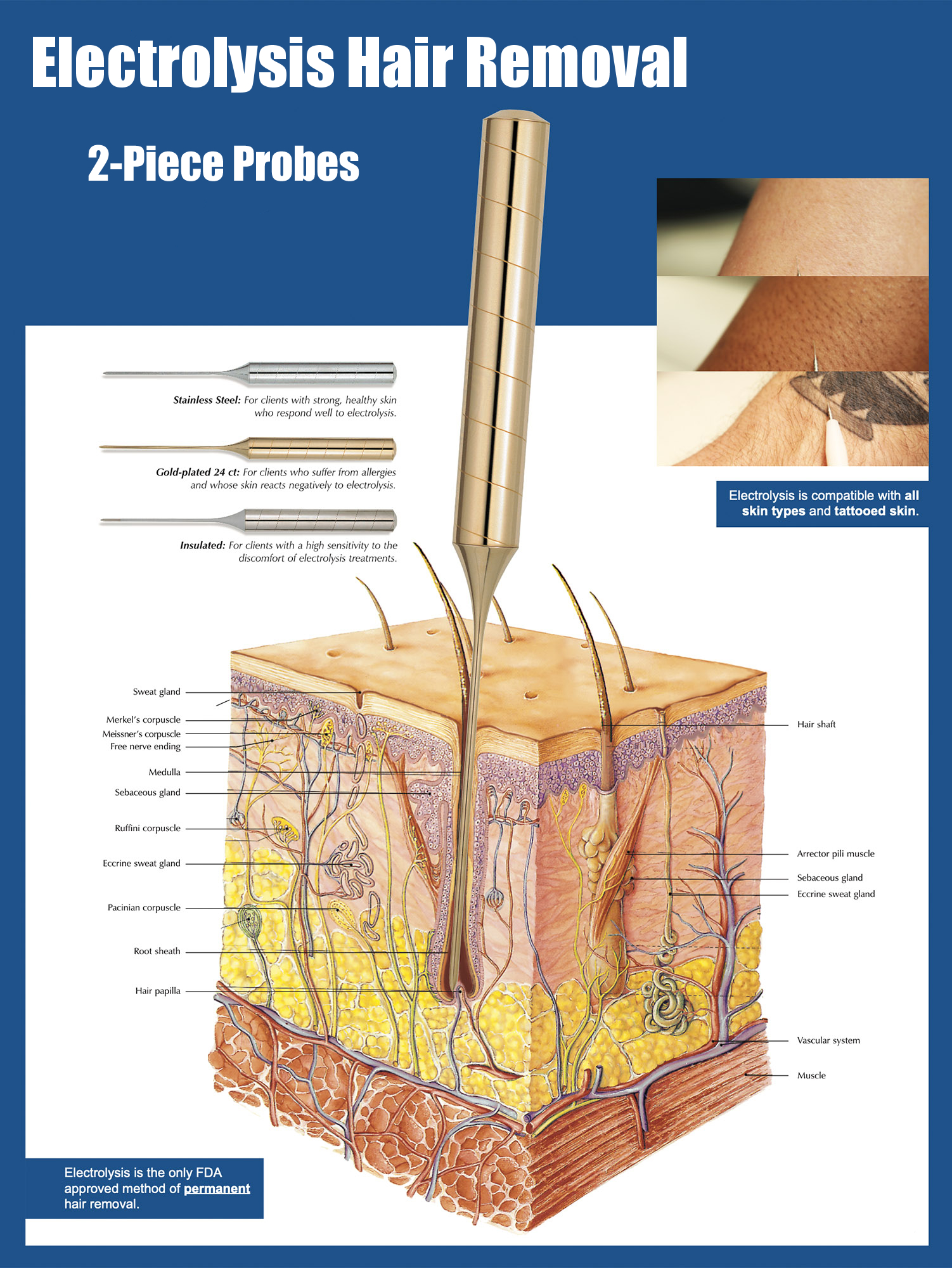
What is Electrolysis ?
Electrolysis removes hair permanently by destroying the cells responsible for hair growth. This is accomplished by entering the opening of the hair follicle and applying a minute amount of current.
There are 2 main modalities, Galvanic and Thermolysis, with the combined use aptly named Blend. Galvanic and Thermolysis both involve the insertion of a probe into the follicle and applying a small amount of current. The difference of method therein lies with the type of current used and its interaction with the moisture within the skin. Depending on the current used, cellular destruction is either achieved either through chemical decomposition (lye) or electrocoagulation (heat).
There is no puncturing or piercing, the probe is inserted into the same opening through which the hair itself emerges. Just as you wouldn't describe the act of sticking a fork in your mouth to be "piercing" the oral orifice, electrolysis does not puncture or pierce the skin, there is no discomfort in the insertion of the probe.
Modality
Galvanic
Known as "traditional" Electrolysis, galvanic involves the interaction of applied current acting upon the water and salt molecules within the follicle to produce lye.
Thermolysis
A relatively newer development in the field, Thermolysis acts upon the physical disturbance of water molecules to produce the heat necessary for cellular destruction. Delving further into the the modalities used, there is standard Thermolysis, and Flash.
Blend
This modality utilizes the heat in Thermolysis to bolster the effects of lye by creating turbulence, whereby allowing the lye to penetrate deeper.
Which Modality is best?
There is no "best" modality. Galvanic, Blend, and Thermolysis, each have their strengths and weaknesses, situations that one or the other is better suited for. Whether one modality is "better" than the other is dependent on the circumstances.
Who Can Get Electrolysis?
While Electrolysis treatment is suitable for all hair and skin types, some areas of the body are not suitable for treatment. The nasal passage, for instance, or other mucous membranes, are far too delicate and prone to infection if treated.
Barring that, there are some medical conditions as well which may impede treatment or compromise the safety of the client. Care should be taken in the treatment of those whose circulation has been compromised, with recovery potentially taking longer in such instances.
Why Electrolysis?
There are a multitude of reasons why someone may choose to undergo Electrolysis treatment. Discomfort, maintainance, appearance, surgery preparations, etc. Many experience chronic ingrowns or dislike shaving. Some want their hairline or brows adjusted, and others never found the hair comfortable to begin with.
Chances are if you have found your way here, then you already knew why, and it can be as simple or complicated as you want it to be. I will not judge you or ask you to share what you aren't comfortable with sharing. You have hair that you don't want, simple as that. When I ask "why", it is solely to better suit your particular needs.
Trivia Corner
The earliest recorded use of electrolysis for hair removal is credited to American dermatologist Dr. Charles Michel in 1875, when he discovered that a small current could be used to destroy hair follicles and began using it to remove unwanted hair growth from patients.
While both Galvanic and Thermolysis are labeled under Electrolysis, Thermolysis does not involve the break down any chemical compounds and is not "true" Electrolysis, but rather referred to as such due to its development in and from the field.